Camel Story — Raising, Training & Racing Records
In brief
Camel Story is a phone-first record book for camel farmers, Bedouin camel keepers, owners and their staff. It keeps each camel’s breeding, daily care, health, training and race results in one plain-language timeline, records by voice or a few taps, and builds a searchable race archive from videos and result sheets.
01 · The challenge
A camel’s history usually lives in memory, notebooks, WhatsApp messages and scattered race videos. When a camel changes name or owner, its past is hard to connect. Training times, feed changes and blood tests sit in different places, so nobody can see the whole story — and good decisions about care, breeding and racing depend on that story.
02 · Who it’s for
Camel farmers and Bedouin keepers, owners with herds across several farms, trainers, caretakers, and veterinarians who record health information. Each person sees only the farms and records their role allows.
03 · The experience
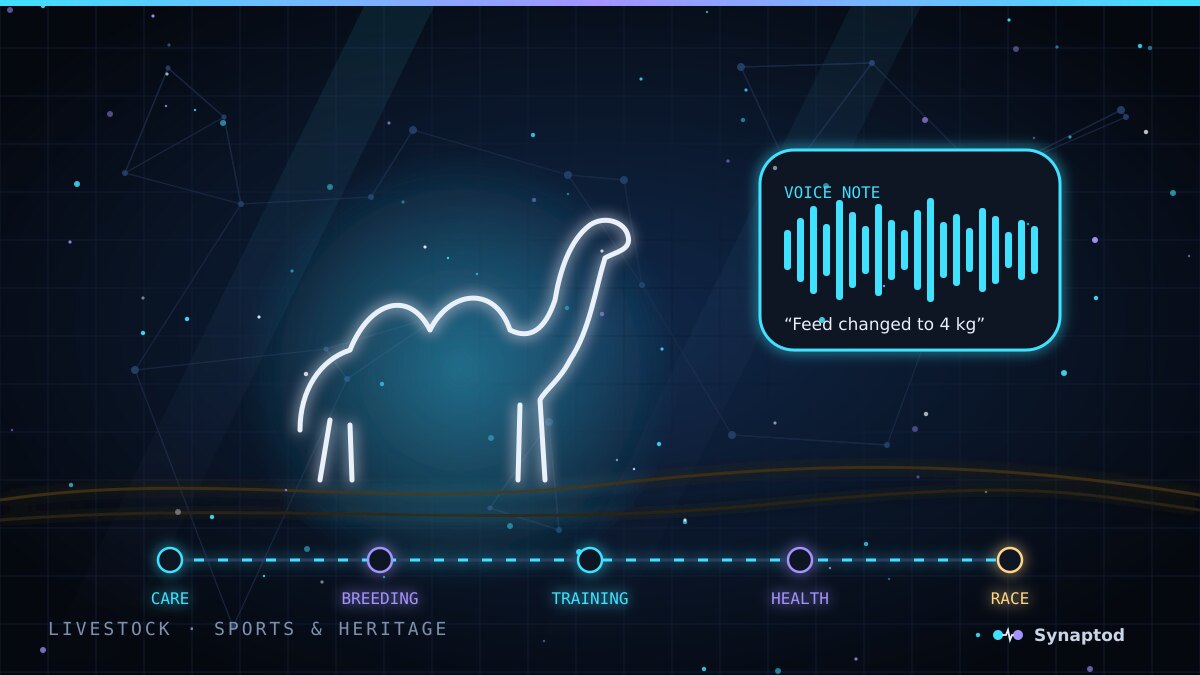
A keeper picks a camel by its photo and says what happened: “Today we changed her feed to four kilos,” or “She trained the 3-kilometre route in five minutes.” The app saves the words and places the details in the right record. Opening a camel shows its life as a story — feed changes, vet visits, pregnancy checks, training sessions and race results in date order. Pasting a race video link or photographing a result sheet adds the race to the archive in the background, without asking the user to confirm every row.
04 · How it works
Under the hood
- Each managed camel has a stable internal ID plus farm tag, microchip and registry numbers when available; name and owner can change without losing history.
- Routine values such as feed quantity carry forward until changed, so staff record only what is new.
- Breeding milestones — readiness, mating, pregnancy checks and birth — link dams, sires and calves with confirmed or reported parentage.
- Race videos and result sheets are read in the background: Arabic names, numbers, owners, placings and times are extracted with their source frame or page.
- Every race entry is kept as its own record at first; matching appearances across races comes later, only when evidence is strong.
- Blood tests and vet reports keep original values, units and reference ranges; training records keep routes, distances, splits and timing method.
05 · Built to grow
Version one collects and organises facts for one or many farms. The next stage links race appearances across events and name changes. Only once enough reliable data exists will the app compare performance and test predictive models. Wearable trackers can be added through file imports first, with direct device sync when a supplier offers a reliable connection.
06 · Added advantages
- A complete, chronological history for every camel, preserved through changes of name and owner.
- Arabic-first, voice-friendly recording designed for life on the farm and at the track.
- A growing archive of race results traceable to the original video or sheet.
- Preserves an important part of Emirati and Gulf heritage in a structured, lasting form.
07 · The human side
The app records; it does not diagnose, prescribe or decide breeding. Unclear information is left blank rather than guessed. Health and breeding records are private to authorised roles, and veterinarians and trainers set any thresholds for recovery or readiness.
Questions people ask
Can I record by voice?
Yes. Keepers can speak or type a short note; the app keeps the original words and places the details into the right care, training, health or breeding record.
What happens when a camel changes name or owner?
Its stable internal ID stays the same, and earlier records keep the name and owner that applied at the time.
Does the app predict race winners?
Not in the first release. It collects reliable facts first; performance comparisons and any predictions come later, once the data supports them.
Does it work with wearable trackers?
It is designed to import common files such as GPX and CSV first, and to add direct device connections only where a supplier provides reliable, camel-compatible data access.
Related cases
Want something like Camel Story — Raising, Training & Racing Records?
Tell us about your setting and we’ll explore it with you.
Last reviewed 2026-11-24